

Parking types explained
Sydney Airport Parking Types Explained
Self-park, undercover, valet and shuttle lots all behave differently on the day you fly. Here is what each type costs you in time, walking and shelter.
Not every car park at Sydney Airport works the same way. A self-park lot, an undercover space, a valet handover and a shuttle-connected lot each change what your trip day looks like. Some are walk-in; some need a transfer. Some protect your car from the weather for weeks; some just get you parked fast. The three flat fields below are the shorthand — walk, cover, shuttle — and every section that follows reads off them.
Self-parking and walk-in lots
You keep the keys, you park, you walk. P2 and P3 at the domestic terminals sit between T2 and T3 and run around the clock.
Undercover parking
A roof over the paint. The difference matters over weeks of Sydney sun and hail, and barely at all across one night.
Shuttle-connected lots
Parked further out, connected by a transfer bus on a fixed loop. Blu Emu is the domestic long-stay example.
Self-parking: the default choice
Self-parking is what most people picture: you drive in, find a space, park, and walk to the terminal. At Sydney Airport, P2 and P3 handle this for the domestic terminals, sitting between T2 and T3 and open around the clock. The appeal is control. You keep your keys, you know exactly where the car is, and there is no handover to arrange.
On return, you walk back to the same level and drive out. For a straightforward domestic trip it is hard to beat, and for a traveller who wants to leave at 3am without waiting on anyone else, that independence is the whole point. What it does cost you is a walk with your bags and a search for a bay on a busy Friday.
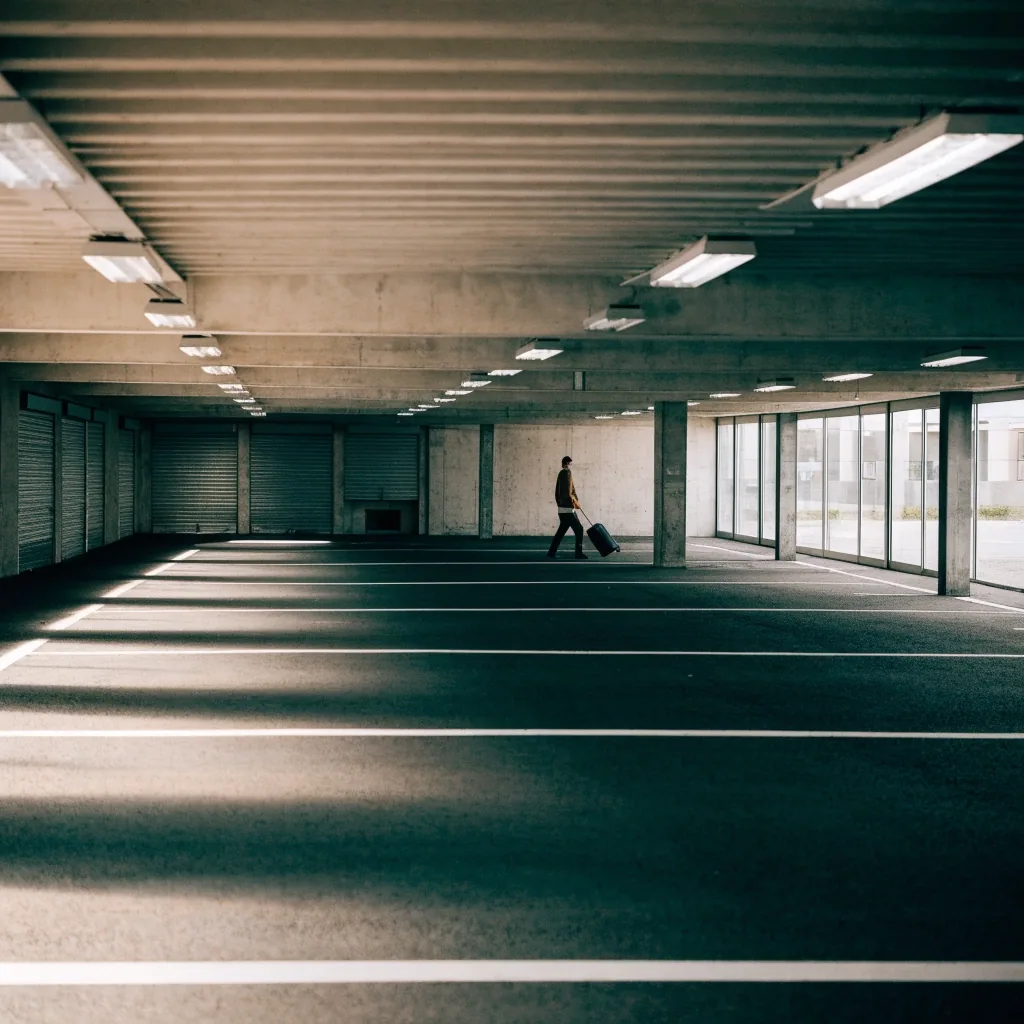
Undercover vs open-air
Sheltered parking
Roof over the car for the whole stay. Paint and interiors sit out of the sun and out of a hailstorm, and a car left for three weeks does not come back with a bleached dashboard. This is the type most off-airport operators advertise as the comfort tier, and it is priced above open-air because of it. Access is usually through a multi-level structure rather than a fenced rooftop.
Open-air parking
A space on a surface lot or an open top deck. Nothing between the car and the weather, which is why the rate sits lower. For an overnight before an early domestic flight it changes nothing you will notice. For a fortnight across January it does. Check which level you are actually booking — some structures are part-covered and only the top deck is open.
The honest rule: shelter matters in proportion to how long the car sits. Match the cover to the length of the trip, not to the price of the upgrade.

Shelter is measured in weeks, not nights
Undercover parking on a Sydney Airport stay is the clearest example of a type whose value depends less on the facility and more on how long you are gone. Two nights under a roof and eleven nights under the same roof are not the same purchase.

Valet parking and the handover
Valet parking is available through Sydney Airport's official booking system, with operating hours that vary by location. You hand the car over near the terminal and collect it on return. The benefit is the walk you don't do and the space you don't hunt for. It suits early flights, heavy luggage and travellers returning late who want to drive straight home.
The catch is the hours. A valet point that closes before your inbound lands turns a smooth handover into a wait, so check the operating window for the specific location you are booking rather than assuming valet runs around the clock. If your arrival falls outside that window, the walk-in structures at P2 and P3 are the reliable fallback.
Suits
Early departures, checked bags, late returns with a drive home ahead.
Check first
The valet point's published hours against your actual arrival time.
Shuttle-connected lots
Some parking sits away from the terminals and connects by a shuttle bus. Off-airport operators advertise this 24/7 transfer as a convenience and value feature, and it is the key difference for lots outside walking distance. Blu Emu is the domestic long-stay example.
How the transfer works
The bus runs a fixed loop between the lot and the terminal, so you wait for the next one rather than calling a car. That adds a step on both ends of the trip and is worth knowing before you time a tight flight.
When it pays off
On trips long enough for the per-day saving to outweigh the extra transfer time. A fortnight at a shuttle lot usually comes out ahead; a single night rarely does.
What to check
Where the pick-up point sits at your terminal, how often the loop runs at the hour you arrive, and whether the lot is covered or open-air — those three answers shift the value more than the headline rate.
Return trip
Coming back, you wait at the terminal kerb for the same loop. Allow a margin if you are collecting a car before a long drive home, and keep the lot's pick-up instructions with your booking.
Which type fits your trip
Match the type to the trip, not the other way around. Convenience and cost pull in opposite directions, and the right answer depends on how long you are gone and how much walking you want with your bags. Read the four rows left to right.
| Type | Where it sits | How you get in | Best for |
|---|---|---|---|
| Self-parking P2 and P3, between T2 and T3 · walk straight in | P2 and P3, between T2 and T3 | Walk — no transfer | Short domestic turnarounds |
| Undercover parking Off-airport structures, covered levels · drive in or shuttle | Off-airport structures, covered levels | Drive in, sometimes a shuttle | Long stays through hot or stormy weather |
| Shuttle lot Away from the terminals · transfer bus on a fixed loop | Away from the terminals | Transfer bus on a fixed loop | Long trips where the per-day saving matters |
| Valet Handover point near the terminal · hours vary by location | Handover point near the terminal | Key handover, no walk | Early flights, heavy bags, late returns |
A short domestic turnaround answers itself — self-parking at P2 or P3. A long holiday from the domestic terminals brings Blu Emu or covered off-airport parking into play. An international departure with a tight schedule points at valet, if the hours line up, and arriving at midnight with kids and bags points there too.
What changes your cost
Two things move the number more than anything else: how long you stay and how close you park. Understand which category you are buying before you compare prices, because the same four days can land in very different brackets.
How long you stay
Daily rates favour short stays at close-in car parks. Once you pass a few days, the per-day rate at a shuttle lot starts to outweigh the transfer time, and covered parking starts to earn its premium.
How close you park
Walk-in car parks charge for proximity. Shuttle lots charge less because they sit further out. Valet costs more again for the handover, and pick-up zones are a different category altogether, with a short free window rather than a daily rate.
Drive-up means taking what is available and paying the day rate. Prebooking locks in a space and a rate, and it is the same logic across all four types: if your plans are firm, book ahead; if they might shift, check the operator's change and cancellation rules first, because flexibility varies by type and provider.
Booking method per type
Whichever type you choose, the airport's platform handles self-park and valet reservations, and off-airport operators run their own booking systems. That split matters when something changes at the last minute: your confirmation, your change rules and your contact point all sit with whoever took the booking.
Booked through the airport
Self-park at P2 and P3, and valet where the location's hours suit your flights.
Booked with the operator
Off-airport lots, covered or open-air, including shuttle-connected sites like Blu Emu.
Not booked at all
Pick-up and drop-off zones, which work on a short free window rather than a daily rate.

Three questions settle it
How long are you away?
How much walking can you handle with your bags?
Do you need covered parking?
Answer those and the type usually picks itself. A one-night domestic trip answers itself. A fortnight abroad brings cover and shuttle value into play. Write the three answers down before you browse, and you will waste far less time comparing options that were never going to fit.
Parking type questions
The four questions that come up most when travellers weigh one parking type against another at Sydney Airport.
Is undercover parking worth it for a short trip?
Usually not. Shelter matters most over long stays through hot or stormy weather, when paint and interiors are exposed for weeks. Across a night or two the difference you notice is small, and the price gap is real.
Does valet parking run 24 hours?
Operating hours vary by location, so check the hours for your chosen valet point before booking, especially for late arrivals. If your landing time sits outside the window, plan around a walk-in car park instead.
What is the difference between a walk-in and a shuttle lot?
A walk-in lot sits within walking distance of the terminal, like P2 and P3. A shuttle lot sits further out and connects by a transfer bus, usually at a lower rate — the trade is time on both ends of the trip.
Can I prebook any parking type?
Self-park and valet can be reserved through the airport's official platform. Off-airport operators, including the shuttle-connected lots, run their own booking systems. Prebooking locks in a space and a rate either way.
Before you decide
Pick the type, then prebook the space
Once you know whether you are buying proximity, shelter or a transfer, the comparison gets short. Check the car parks by terminal, run through the prebook steps, or open the map and see where each lot sits relative to your arrivals hall.
Still weighing two options? Tell us your travel dates, terminal and how long the car stays, and we will point you at the type that fits.
- Address
- 20 Loftus St, Sydney NSW 2000, Australia
- Phone
- +61 2 9247 1234
- Hours
- Open 24 hours, 7 days a week